
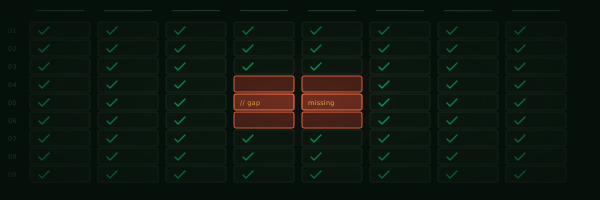
A set of assessment tools can map to every Performance Criterion and every Knowledge Evidence item, satisfy the assessment conditions, pass an audit clean, and still hand a learner a qualification they can’t actually perform at.
That reads like a contradiction. It isn’t. It’s one of the most common things we find in materials that have already been signed off as compliant, and it’s almost invisible from the inside, because every signal you’d normally trust says the materials are fine.
A knowledge assessment that passed
Picture a Diploma-level unit, something in the leadership or management space. The kind where the learner is meant to lead a team, make decisions under pressure, and change course when the situation doesn’t go to plan. The project task is built well: a realistic brief, a simulated team, decisions the learner has to own.
Now look at the knowledge assessment sitting underneath it. The questions read like this:
- List the stages of the risk management process.
- Identify three methods for monitoring team performance.
- What are the key features of an effective consultation process?
Every one of those maps to a Knowledge Evidence item. The mapping document is honest; the coverage is real. An auditor checking the matrix ticks it off, because the knowledge is, technically, assessed.
What the learner actually has to do
Read those three questions again and ask what a learner has to do to answer them. They have to remember a list. That’s the whole task.
Open the learner guide, find the bulleted section headed “the risk management process,” and copy it across. Same for performance monitoring. Same for consultation. A learner can complete the entire knowledge assessment without making a single judgement, weighing one option against another, or deciding what to do when the textbook answer doesn’t fit the situation in front of them.
Judgement under messy conditions is the whole point of a Diploma. It’s the difference between the level on the testamur and the one below it.
The consequence no audit will surface
So the learner passes. The RTO passes. The testamur says the graduate can lead and manage. Then they’re in a real role, facing a real version of the scenario, and step three of the five-step process they memorised doesn’t apply, and nobody ever assessed them on what to do then.
The graduate doesn’t know they have the gap. The RTO doesn’t know its materials created it. The employer just knows the person they hired with a Diploma can recite a framework and can’t run a project. By the time anyone sees it, it’s three steps removed from the assessment tool that caused it, and no-one connects it back.
Nothing in the audit chain catches this. An audit checks that the knowledge evidence is covered and the conditions are met. It does not check whether the cognitive demand of the question matches the level on the testamur. Validation, run by people working from the same mapping matrix, usually doesn’t either, because the matrix says “covered,” and the matrix is right.
Why AI tools widen the gap
This is exactly the gap a generic AI tool makes worse. Ask a model to write a knowledge assessment from a unit’s Knowledge Evidence list and it gives you questions that hit every keyword in that list. Keyword coverage is what it optimises for, because keyword coverage is what looks complete. “Risk management process” is in the evidence, so a question about the risk management process is in the assessment. It maps. It looks done.
What the tool doesn’t ask is whether “list the stages” is the right demand for a Diploma, or whether the question should force the learner to choose, justify, and adapt. That call isn’t in the unit document. It comes from knowing what the level actually means and reading each question against it. A tool that starts from the TGA document and a prompt has no way to make that call, so it doesn’t. It produces something that passes the check it can see and fails the one it can’t.
You might have this right now
Here’s the uncomfortable part. If this is in your materials, nothing in your normal process will tell you. Your mapping matrices will look complete, because they are. Your last audit was clean, because this isn’t what an audit looks for. Your validation sign-off is on file, because validation worked from the same matrix. Every normal signal says the materials are fine.
The only way to find it is to read every assessment question against the level it’s pitched at, one at a time, across the whole qualification. Most teams don’t have the hours, and weren’t looking, because nothing flagged it.