
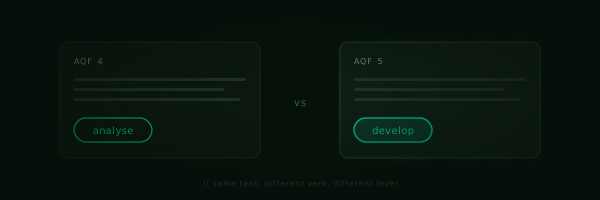
A Certificate IV assessment and a Diploma assessment often look identical on the page. Same format, same length, same kind of task. Open them side by side and the layout will not tell you which is which.
The difference is not in the format. It is in the cognitive demand. And because that demand is not something the mapping matrix records, an assessment can sit a level too high or too low and still map perfectly clean.
I have written before about why that gap is invisible until a graduate starts the job. This post is the practical companion: how to actually read the altitude of a task, using the two levels people confuse most, Level 4 and Level 5.
What separates the two levels
The AQF descriptors are precise about this, even though the qualifications can feel close.
Level 4, Certificate IV. The graduate has broad knowledge with some theory. They exercise judgement and select between options in known or changing contexts, within set parameters. The key shift from Certificate III is that they are no longer just following a procedure. They are choosing an approach and explaining why. The verbs that belong here are analyse, evaluate, select, adapt, justify.
Level 5, Diploma. The graduate has technical and theoretical knowledge. They analyse a situation and develop a planned response. Not fill in a template, develop one. A plan, a strategy, a document that did not exist before they started. They hold defined responsibility within broad but established parameters. The verbs that belong here are analyse, plan, develop, coordinate, evaluate, advise.
The overlap is real. Both levels analyse and evaluate. That is exactly why they get confused. The line is not the analysis. The line is what the learner produces and how much of it they originate.
At Level 4, the learner works within an existing framework and chooses well inside it. At Level 5, the learner builds the framework.
How to read a task in three moves
When I check a task, I read three things, in this order.
1. The command verb. This does most of the work. "Follow" and "complete" sit low. "Analyse, evaluate, justify" sit in the Level 4 band. "Develop, plan, advise, coordinate" lift it to Level 5. A single verb can move the whole task without anyone deciding it should.
2. The autonomy and context. A known, stable situation with one reasonable answer sits lower. A situation with some variables, changing conditions, or several stakeholders sits at Level 4. A situation where the learner has to plan a response across moving parts sits at Level 5.
3. The output. Apply a procedure or fill a supplied template, lower. Choose between methods and justify the choice, Level 4. Produce an original plan or strategy, Level 5.
If the verb, the context, and the output all agree, the task is on level. When they disagree, the task has drifted, and the highest of the three is usually where the real demand sits.
Worked example one: a Diploma task quietly doing Certificate IV work
Here is a task from a Diploma unit.
"Identify the consultation requirements in your organisation's WHS policy and list the steps you would follow to meet them."
The content is Diploma content. The verb is not. "Identify" and "list the steps you would follow" ask the learner to locate and reproduce an existing procedure. That is application, not planning. There is nothing for the learner to develop.
Pitched correctly for Level 5, the same content reads:
"Analyse your organisation's current WHS consultation arrangements and develop a plan to improve how consultation reaches frontline workers."
Now the learner is analysing a real situation and producing something that did not exist before. Same topic. Diploma altitude.
Worked example two: a Certificate IV task that has floated up
Now the other direction, from a Certificate IV unit.
"Evaluate the effectiveness of your organisation's risk management framework and design a replacement model that addresses its weaknesses."
"Design a replacement model" is Level 5 work, arguably higher. It asks the learner to originate a framework, under conditions that are open-ended. A Certificate IV learner is meant to work within a framework and exercise judgement inside it, not rebuild it from scratch.
Pitched correctly for Level 4:
"Review your organisation's risk management framework against the relevant code of practice, and recommend which two controls you would strengthen first. Justify your choice."
The learner still evaluates and justifies, which is squarely Level 4. They are no longer being asked to design a new system. The altitude comes back down to the qualification.
Why neither the matrix nor validation reliably catches this
In both examples, the task still maps. It still touches the performance criteria it is supposed to touch. Coverage holds. The mapping matrix has no column for altitude, so it shows green either way.
Validation often cannot catch it either, because the validator usually works from the same matrix as the person who built the assessment. If the question being asked is "is it covered", the answer is yes. Whether it is "pitched right" is a different question on a different axis, and it has to be asked on purpose.
That is the practical takeaway. Level is not something you catch by accident while checking coverage. You catch it by looking at it separately, deliberately, as its own check.
A quick way to check your own
I built a free check for exactly this. You paste an assessment task and the level your qualification claims, and it tells you whether the cognitive demand matches, and which word lifted or dropped it. It runs in whatever AI tool you already use, no sign-up. You can try it on a task you have already written.
A note on what it is and is not. It is a design check, a fast second read on altitude. It does not validate your assessment, confirm coverage, or replace your validation process. Your named subject matter expert signs off on every assessment. The point is simply to make the one thing the matrix never shows you visible early, while it is still easy to fix.