
Here is a conversation that happens more than it should. An RTO buys “course materials” for a unit. The materials arrive. It is a learner guide. A good one, even. Then someone asks where the assessments are, and where the assessor guide is, and which documents the project task is supposed to use, and whether anyone mapped it to the unit of competency. The answer is: those were not in what you bought.
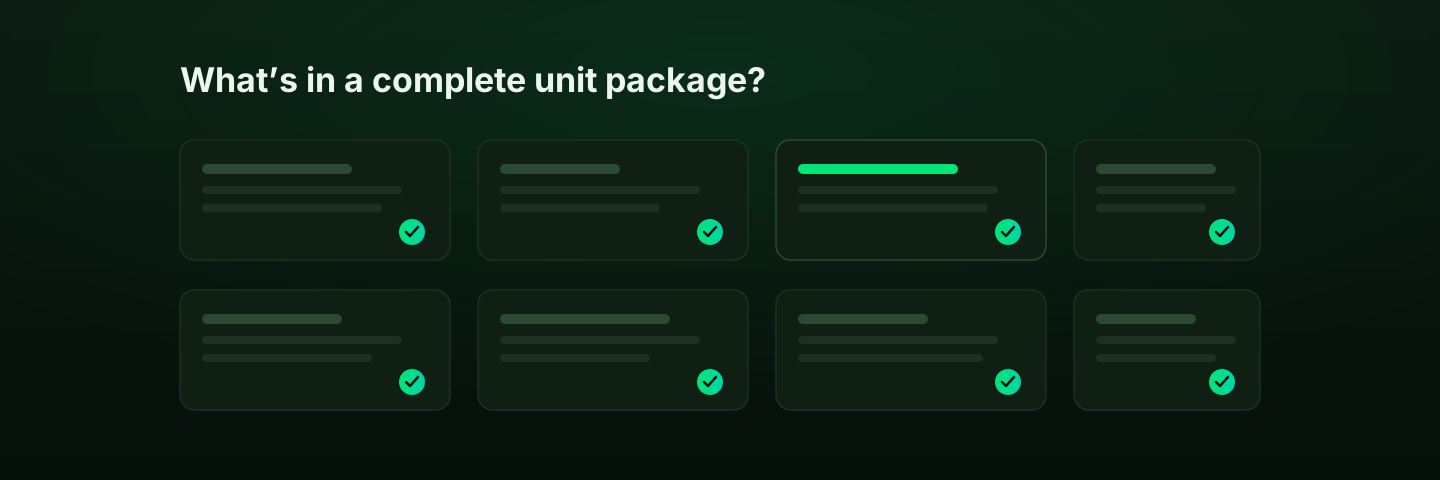
A learner guide on its own is a reading list. It is the part learners see and the part that is easiest to produce, which is exactly why it is often the only part that gets produced. The documents that make a unit deliverable, and defensible at audit, are the ones nobody puts on the cover. Here is the full list, what each one does, and why each one matters when an auditor is in the room.
The complete package, document by document
Learner guide
The teaching content. For a properly built unit that is 8,000 to 15,000 words across five or more modules, pitched at the right AQF level, with Australian industry examples and your simulated organisation woven through. This is the part everyone means when they say “materials,” and it is one document of several.
At audit: shows the knowledge is taught before it is assessed.
Knowledge assessment
Short-answer questions covering the Knowledge Evidence. Done well, the questions demand the level of thinking the qualification claims, not just recall of a list. Done badly, they map to every evidence item and still let a learner pass by copying a heading out of the guide.
At audit: evidence the Knowledge Evidence is assessed, not just covered.
Project assessments (1 to 2 per unit)
The tasks where the learner does the work the unit is about, set inside a simulated organisation with realistic documents and a real brief. This is where Performance Criteria and Performance Evidence are demonstrated. Assessment conditions are stated plainly so the assessor knows what is required.
At audit: evidence of performance under the required conditions.
Assessor guide
Marking rubrics, benchmark answers, reasonable adjustment notes, and instructions for every task. This is what lets a trainer mark consistently without going back to the unit descriptor each time, and what lets two assessors reach the same decision on the same evidence.
At audit: evidence assessment is consistent and the decision rules are documented.
Simulated workplace documents
Every policy, procedure, form, register, email, or report a project task refers to has to actually exist. A task that says “review the WHS register” needs a WHS register. These are branded to your simulated organisation, not generic templates, and they are the single biggest reason two RTOs running the same unit end up with materials that do not read the same.
At audit: evidence the simulated environment reflects real workplace conditions.
Compliance mapping matrix
Every Performance Criterion, Performance Evidence item, Knowledge Evidence item, and Foundation Skill traced to where it is taught in the guide and where it is assessed. This is the document a compliance team and an auditor reach for first, because it answers the only question that matters: is everything covered, and can you show where?
At audit: the map that proves coverage in minutes instead of days.
QA report
A PASS or FAIL checklist mapped to the ASQA 2025 Standards, showing exactly what was checked and what evidence exists. It is the documented basis your subject matter expert uses for their sign-off, rather than signing off on a feeling that it looks right.
At audit: evidence a quality check happened and what it found.
LMS-ready HTML
Each module formatted as a clean HTML page that pastes into Canvas or your LMS without the formatting breaking. This is the difference between “here is a Word file, good luck” and content that is ready to put in front of learners after upload. On project builds this runs after your sign-off.
Not an audit document, but the difference between materials that get used and materials that sit in a drive.
If a quote does not name all eight, ask which ones are missing. The gap is almost always items 04 through 07, the documents that turn a learner guide into something that survives an audit.
Why the missing documents are the expensive ones
The learner guide is the cheap part to produce and the safe part to sell, because everyone can see it. The assessor guide, the simorg documents, and the mapping matrix are the parts that take real VET knowledge to get right, and they are also the parts an auditor scrutinises hardest. When those are left out, the cost does not disappear. It lands on your team, usually months later, usually under deadline pressure, usually when someone realises the “complete” materials cannot actually be delivered as they are.
This is the complete list I deliver for every unit, in one go, at one fixed price. Not a learner guide with the rest available as add-ons. The whole package, because anything less is not finished.