
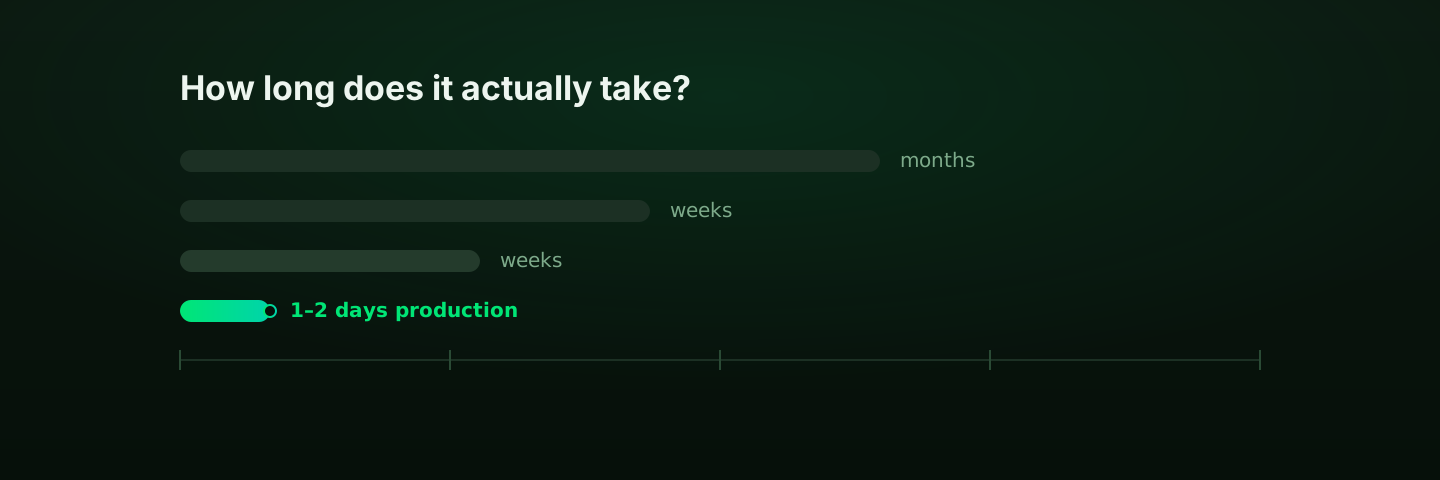
Nobody in the RTO resources industry will give you a straight number. Catalogues talk about “ready-made” without saying how long a custom job takes. Consultancies quote a range and then quote a different range once they have seen the unit. So here is the honest version, with the timelines I have actually watched play out, and what each one does and does not include.
The first thing to be clear about: there are two numbers, and people quote whichever one suits them. There is production time, the hours of actual building, and there is elapsed time, the calendar from “go” to “ready to deliver.” A vendor who says “a few hours” is quoting production time and hoping you do not ask about review. A consultancy that says “three months” is quoting elapsed time and counting every queue and approval gate in between.
The four ways an RTO gets a unit built
| Approach | Time per unit | What that time buys |
|---|---|---|
| In-house build | 4–5 days production, often 4–12 weeks elapsed | A learner guide and assessments, if the person doing it is not also delivering training that week. Mapping and simorg documents usually come later, if at all. |
| Freelance instructional designer | 2–4 weeks elapsed per unit | Strong writing, variable VET-assessment depth. Quality depends entirely on the individual. You manage and chase. |
| SaaS / generic AI tool | Hours | Learning content fast, but your team prompts, edits, and finishes it, and the tool does not produce assessor guides, simorg documents, or compliance mapping. |
| Configured pipeline (Learnbuilt) | 1–2 hours production, 24–72 hours elapsed | The full stack: learner guide, knowledge and project assessments, assessor guide, simorg documents, compliance mapping, QA report. Your SME reviews and signs off. |
Those in-house numbers are not a swipe at internal teams. They are what it takes one capable person to do the job properly. The problem is almost never capability. It is that the capable person is a trainer who is mid-delivery, and the unit is the thing that gets pushed to next week, every week, until a deadline turns it into a crisis.
Why “a few hours” is a half-truth
You can generate a learner guide in an afternoon. That part is real. What that afternoon does not produce is the assessment suite mapped to every Performance Criterion, the assessor guide with marking benchmarks, the simulated workplace documents the project tasks actually reference, the compliance matrix an auditor reaches for, and a QA pass against the unit requirements.
Strip those out and you have not saved time. You have moved the work onto your team and called it done. The hours did not disappear. They moved to whoever has to finish it, and that person is usually the one who had no time in the first place.
The honest measure is not how fast you get a document. It is how fast you get to a package your SME can sign off and put in front of learners.
What my 24 to 72 hours actually covers
When I say a unit moves end to end in one to three days, here is what is happening in that window. The pipeline parses the training package and calibrates to the right AQF level. It writes the full learner guide, then the assessments, against your configured simulated organisation and learner profile. A human review gate at Stage 07 checks coverage against the unit requirements and the Standards for RTOs 2025 before anything is formatted. The branded documents land in your Google Drive.
Then it is your turn. Your subject matter expert reviews the materials, asks for any corrections, and signs off. That review window is part of the elapsed time and it is the part you control. Some SMEs turn a unit around in a day. Some take a week because they are busy. Either way, the production bottleneck that used to define the timeline is gone.
So what should you budget?
If you have a single unit and an SME who can review promptly, plan for the back half of a week. If you have a full qualification with a transition deadline, the maths changes completely. Twelve units that would have queued behind each other for months internally can be produced in parallel and delivered to your Drive as they complete, so your SME is reviewing unit three while I build unit eight.
I am transparent about this because nobody else is. The number is short, but it is not magic. It is short because every decision that normally slows a build, the AQF calibration, the simorg configuration, the assessment structure, the compliance checks, was made before the writing started and is applied the same way every time.